Timanfaya National Park
Timanfaya National Park
Born from the eruptions of 1730–1736, Timanfaya is Lanzarote's most spectacular national park: glowing cones, palpable underground heat and an entirely preserved lunar landscape.
Timanfaya National Park occupies the center-west of Lanzarote, covering approximately 51 km². It encompasses a volcanic field created by eruptions in 1730–1736 and 1824 — among the longest in modern European history. Solidified lava, volcanic cones and glowing soils compose a lunar landscape where subsurface heat remains perceptible just centimeters below ground. No vegetation, no terrestrial animals: the park is one of Spain's most pristine ecosystems.
Quick Reference
- Admission: paid (ticket included in the mandatory scenic bus ride through the park interior)
- Access: car recommended from Arrecife (~40 min) or Puerto del Carmen (~30 min); parking on-site
- Suggested duration: 2 to 3 hours (scenic bus + geothermal demonstrations)
- Absolute rule: leaving marked trails is prohibited; no free hiking without an authorized guide
- Attire: closed-toe shoes recommended, sun protection essential (no shade)
- Accessibility: the scenic bus is wheelchair-accessible; guided walking trails cross irregular volcanic terrain
What You'll See
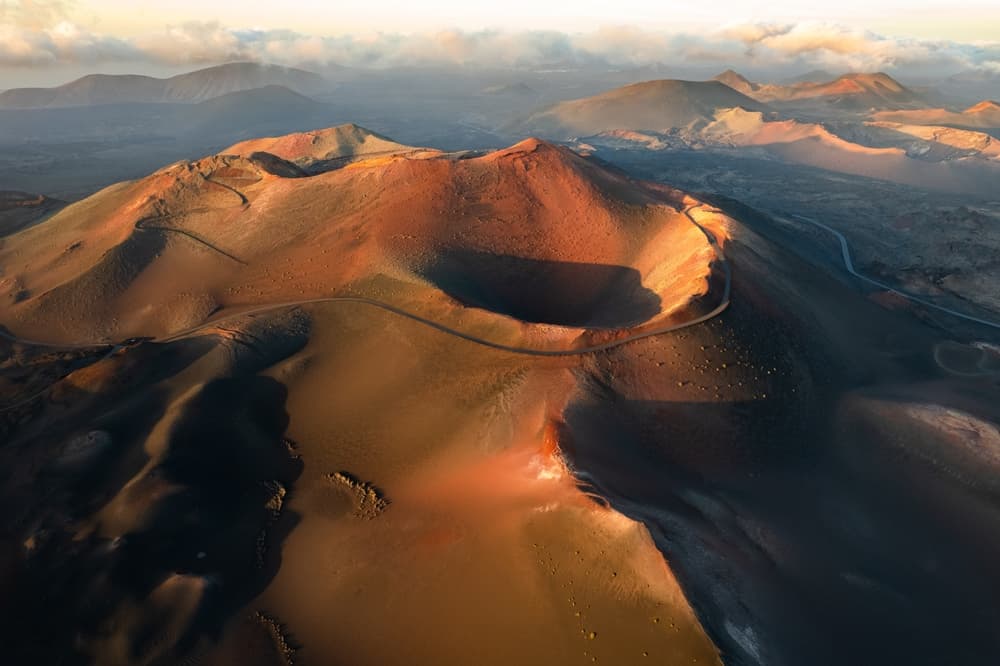
The landscape is dominated by the Montañas del Fuego (Mountains of Fire), a chain of volcanic cones in ochre, red and black hues. Smooth pahoehoe lava intermingles with fragmented, sharp aa lava. Fissures in the ground release vapor, and subsurface temperatures exceed 100 °C at shallow depths.
The El Diablo restaurant, designed by César Manrique, cooks food using natural geothermal heat — a unique experience in the world.
History and Context
Between 1730 and 1736, a series of eruptions destroyed roughly a dozen villages and buried a quarter of Lanzarote under lava. The priest of Yaiza, Andrés Lorenzo Curbelo, left a valuable written account. Another eruption occurred in 1824. The national park was established in 1974; UNESCO incorporated it into the Lanzarote Biosphere Reserve in 1993.
César Manrique, a lanzaroteño artist and architect, played a decisive role in designing the visitor center and restaurant in complete harmony with the volcano.
Highlights of Your Visit
The Scenic Bus (Ruta de los Volcanes)
A mandatory bus circuit through lava flows, calderas and cones. The driver provides commentary on the landscape. It's the only legal way to penetrate the park's interior without an authorized guide.
Geothermal Demonstrations
In front of the visitor center, rangers pour water down a tube planted in the ground: a geyser shoots up within seconds. Twigs tossed into a fissure ignite spontaneously. These demonstrations vividly illustrate the residual heat from the magma.
El Diablo Restaurant
Designed by César Manrique atop a volcanic cone, it harnesses geothermal heat as its cooking source. The panoramic view across the Montañas del Fuego is breathtaking. Reservation advised.
Guided Walking Trails
Several hiking routes (Tremesana, La Rasca) are accessible only with an authorized park guide, in small groups. They allow close observation of lava formations and emerging vegetation recolonization.
Photography Tips
Raking morning and late-afternoon light accentuate texture and color contrasts in the flows. Lanzarote's often-clear skies favor longer focal lengths to isolate individual cones. Avoid midday: glare off black lava easily overexposes. Geothermal demonstrations (vapor, flames) photograph beautifully against the light.
Location and Access
The park stretches between the municipalities of Tinajo to the north and Yaiza to the south. The main entrance is on the LZ-67, accessible from Yaiza. From Arrecife (Lanzarote's capital), allow roughly 40 minutes by car. No regular bus service directly serves the park; a rental car remains the most practical option. Organized excursions from Puerto del Carmen, Costa Teguise or Playa Blanca include transportation.
Immediately nearby, Salinas de Janubio merits a stop on your return route toward Yaiza.
Nearby Attractions
- Salinas de Janubio — the Canaries' largest salt pans, with geometric patterns visible from the coastal road.
- El Golfo — an emerald lagoon nestled in a crater half-collapsed onto the western coast.
- Los Herrideros — lava cliffs where the sea rushes into natural tunnels, creating a spectacular boiling effect.
- La Geria — a unique vineyard worldwide, planted in volcanic ash craters, producer of Lanzarote's malmsey wine.
Interested in this visit?
We can include it in your personalised itinerary.