Betancuria
Betancuria
Once the capital of Fuerteventura, Betancuria preserves its 17th-century baroque church, Franciscan ruins and archaeological museums within an isolated volcanic valley setting.
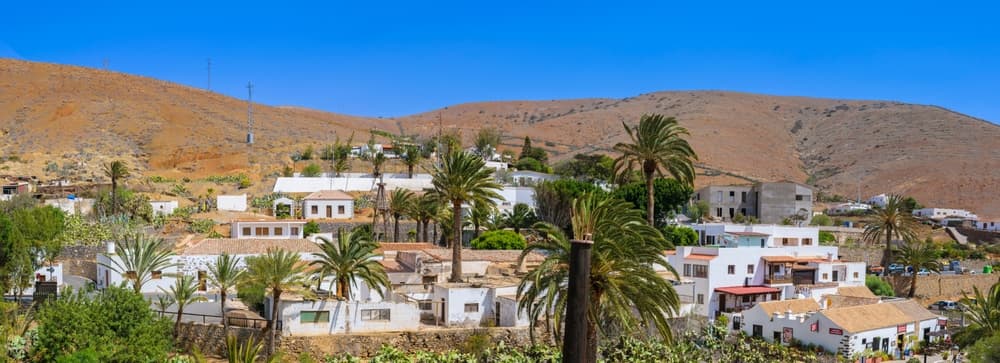
Betancuria is the former capital of Fuerteventura, nestled in a volcanic valley in the centre-west of the island. Founded in the 15th century by Norman conquistador Jean de Béthencourt, it remains the island's best-preserved village. Its cobbled streets, whitewashed houses and baroque church create a striking contrast with the arid landscapes surrounding it.
Quick Reference
- Access: Car recommended — the FV-30 road from Puerto del Rosario crosses spectacular mountain scenery.
- Recommended duration: 2 to 3 hours for the village and its museums.
- Dress code: Smart casual required to enter Santa María church.
- Accessibility: The historic centre is largely cobbled and not well suited for wheelchairs.
What to See
The village revolves around the Santa María de Betancuria church, a 17th-century baroque building erected on the ruins of a Franciscan cathedral destroyed by Moroccan pirates in 1593. Nearby, the Museo de Arte Sacro houses liturgical pieces and religious artworks linked to the island's conquest history. The Museo Arqueológico, across the street, displays relics of Fuerteventura's ancient Guanche inhabitants.
History and Context
Jean de Béthencourt founded Betancuria around 1404, selecting this sheltered site for protection from pirate raids originating from the coast. The town became the first capital of the Canaries under European rule. It retained this status until the 19th century, when Puerto del Rosario supplanted it. Its relative isolation has paradoxically preserved its colonial urban fabric.
Highlights of Your Visit
Santa María de Betancuria Church
The church dominates the central square. Its sober volcanic stone façade contrasts with a richly decorated interior: Mudéjar coffered wooden ceiling, gilded retables and a processional cross attributed to the earliest days of conquest. It is one of the Canaries' oldest religious buildings still in active use.
Franciscan Convent Ruins
Behind the church, the ruins of the San Buenaventura convent testify to the Franciscan presence from the 15th century onwards. Partially standing walls and the interior garden offer a distinctive atmosphere, far removed from tourist bustle.
Archaeological Museum
The museum traces the life of the Mahos, a pre-Hispanic Berber people of Fuerteventura. Pottery, stone tools and reconstructions help bring to life a civilisation often overshadowed by conquest history.
Morro Velosa Viewpoint
On the road leading to Betancuria from the north, this vantage point offers a panoramic view over the valley and volcanic ridges. Two monumental statues of ancient Maho kings, Guize and Ayose, mark the site.
Etiquette and Visiting Rules
- Shoulders and knees covered when entering Santa María church.
- Quiet and discretion inside the church, which remains an active place of worship.
- Photography is generally permitted in the church, but check for signs on site.
Photography Tips
Morning light is ideal for photographing the church façade, which faces east. The alleyways around the central square, with their whitewashed walls and dark wooden doors, lend themselves well to village portraits. From the Morro Velosa Viewpoint, late afternoon light reveals the valley's volcanic relief.
Location and Access
Betancuria lies in the centre-west of Fuerteventura, roughly 30 km from Puerto del Rosario via the FV-30. The road is winding and crosses arid mountain terrain. There is no regular tourist bus service; a rental car remains the most practical option. The village is also accessible from Antigua or Pájara via secondary roads.
Nearby
- Antigua — agricultural village with a restored windmill and goat cheese museum.
- Pájara — quiet village whose church features a sculptured portal with pre-Columbian motifs, unique in the Canaries.
- Morro Velosa Viewpoint — vantage point on the northern route, overlooking the entire Betancuria valley.
Frequently asked questions
Betancuria can be visited year-round. Spring (March–May) offers mild temperatures and greener vegetation in the valley. In summer, midday heat can be intense; opt for an early morning visit.
Yes, a car is virtually essential. There is no regular public transport link from beach resorts. The FV-30 road from Puerto del Rosario is well-maintained but winding.
Yes. Betancuria pairs easily with the Morro Velosa Viewpoint (en route), then Antigua and its windmill. A few hours suffice for the village itself.
Betancuria's museums are usually closed on Sundays. Check current opening hours with Fuerteventura's tourist office before your visit, as they may vary seasonally.
Betancuria has a few restaurants serving traditional Canarian cuisine — goat, local goat cheese, mojo. The selection is limited; it's best to arrive before 2 pm to ensure a table.
Interested in this visit?
We can include it in your personalised itinerary.