Volcán Teneguía
Volcán Teneguía
Teneguía, which erupted in 1971, is La Palma's most recent historic volcano. Hike across black lava, vineyards on ash, and enjoy Atlantic views at the island's southern tip.
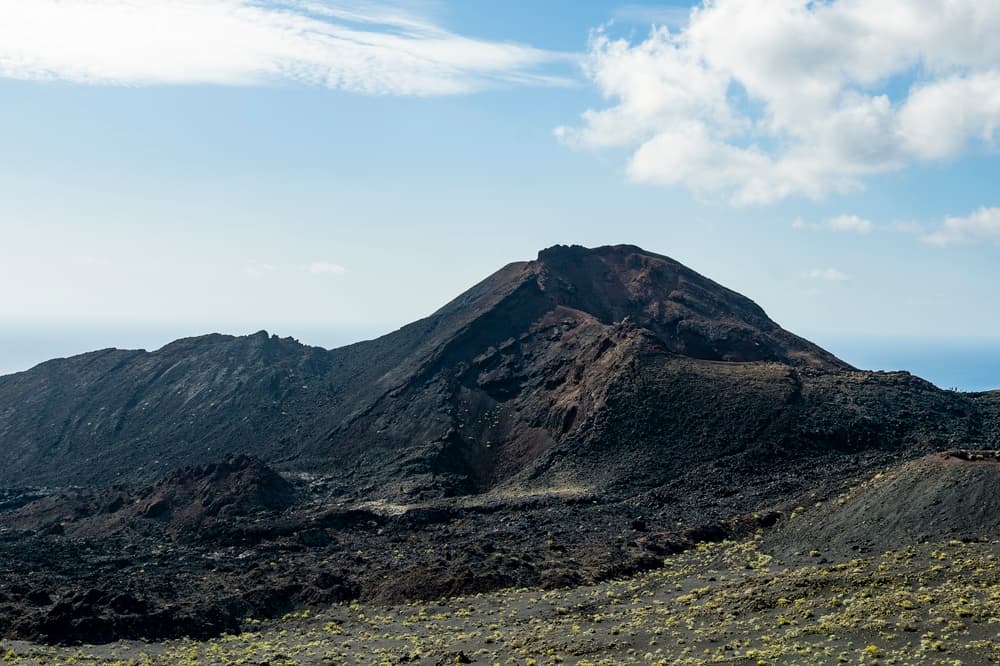
Teneguía is La Palma's most recent volcano: it erupted in October–November 1971, making it one of the youngest historic volcanoes in the Canaries archipelago. Perched at the island's far south, in the municipality of Fuencaliente, it dominates a landscape of black lava and vineyards cultivated on volcanic ash. Its raw silhouette and residual fumaroles make it a striking hiking destination.
Quick Practical Info
- Access: LP-2 road to Fuencaliente, then marked trail toward the volcanic cone.
- Recommended duration: 2 to 3 hours for the loop around the cone and descent to the coast.
- Gear: hiking boots are essential — scoriaceous lava is sharp and unstable.
- Restrictions: certain crater-edge zones may close during periods of heightened seismic activity; check with the Cabildo de La Palma before you go.
- Accessibility: the volcanic trail is not accessible to people with reduced mobility.
What You'll See
The main cone rises to roughly 428 meters. The 1971 lava flows covered several square kilometers and reached the sea, creating new coastal terrain. You can clearly distinguish different lava textures: smooth pahoehoe and rough, scoriaceous aa. Pioneer vegetation—tabaibas, cardons—slowly recolonizes the dark flanks.
History and Context
The eruption began on October 26, 1971, and lasted twenty-four days. It claimed one life—an elderly man caught by toxic gases—and destroyed several houses and crops. It was the first historic eruption at Fuencaliente since San Antonio in 1677. The two neighboring cones, Teneguía and San Antonio, today form a visitable volcanic complex that chronicles five centuries of eruptive activity in the same sector.
Highlights of Your Visit
The Teneguía Crater
The trail ascends to the crater rim, roughly one hundred meters across. On calm days, gentle fumaroles still escape from the ground. Views sweep across the southern coast and the Atlantic in all directions.
The Fuencaliente Vineyards
At the volcano's base, winemakers cultivate malmsey and other local grape varieties directly on the ash from 1971. The basket-trained vines, sheltered from wind by low stone walls of volcanic rock, produce dry white wines recognized under the Vinos de La Palma appellation.
The Lava Coast and Salt Ponds
Descending toward the sea, the trail runs alongside frozen flows that formed dramatic new cliffs. Nearby are the Fuencaliente Salt Ponds, where migrating flamingos nest.
The Neighboring San Antonio Volcano
A few hundred meters away, the Volcán San Antonio hosts an interpretation center that contextualizes La Palma's volcanic history. Combining both visits in a half-day is logical and enriching.
Photography Tips
Raking light at dawn and dusk accentuates the black lava's textures. From the crater rim, the contrast between dark flows and the blue Atlantic is particularly striking. Avoid midday in summer: heat reflected off the black rock is intense and light is flat. A polarizing filter helps manage reflections on polished lava.
Location and Access
Teneguía sits at La Palma's southern extremity, roughly 30 km from Santa Cruz de La Palma via the LP-2. Fuencaliente is the nearest village. Regular buses connect Santa Cruz to Fuencaliente, but frequency is limited; a rental car is the most practical option. The parking area at the base of San Antonio serves as the usual starting point for both cones.
Nearby Attractions
- Volcán San Antonio — the 1677 cone with a volcanic interpretation center, minutes on foot away.
- Fuencaliente Salt Ponds — working traditional salt ponds, a birdwatching site on the lava coast.
- Fuencaliente Lighthouse — the island's southernmost point, with panoramic views of the Atlantic and El Hierro on clear days.
- Ruta de los Volcanes — a long-distance trail traversing La Palma's volcanic ridge from north to south.
Interested in this visit?
We can include it in your personalised itinerary.