Roque de los Muchachos
Roque de los Muchachos
At 2,426 meters, Roque de los Muchachos offers sweeping views across all of La Palma and is home to one of the world's most prestigious astronomical observatories, beneath skies protected by law.
Roque de los Muchachos rises to 2,426 meters at the peak of La Palma. It is the highest point on the island and one of the most renowned astronomical observation sites in the world. The panorama encompasses the entire island, the Canaries Sea, and on clear days, neighboring islands. The air is thin, vegetation nearly absent, and the light possesses a rare clarity.
Quick reference guide
- Access: LP-4 road from Santa Cruz de La Palma or from El Paso — winding mountain road, vehicle recommended.
- Admission: free access to the summit and viewpoints.
- Suggested duration: 1 to 2 hours on-site to enjoy the panorama and explore the crater's edges.
- What to wear: warm clothing essential even in summer — temperatures at the summit are significantly lower than at sea level.
- Altitude: 2,426 m — bring water and protect your skin from the sun (high UV radiation).
- Observatory: the Roque de los Muchachos (ORM) telescopes are not open for casual visits; open house days are occasionally organized by the IAC (Instituto de Astrofísica de Canarias).
What you'll see
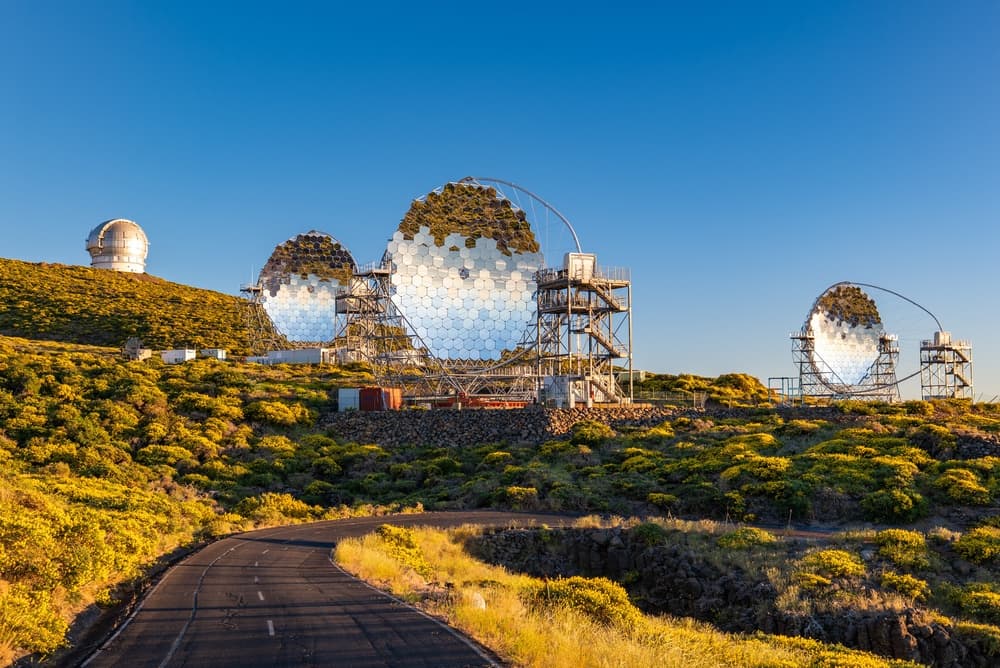
At the summit, white domes of telescopes from the Observatorio del Roque de los Muchachos punctuate a lunar landscape of black volcanic rock. On clear days, views plunge into the Caldera de Taburiente, a protected national park, and extend to Tenerife, El Hierro, and La Gomera. The sea of clouds — mar de nubes — often spreads below, forming a cotton-like blanket between 1,000 and 1,500 meters.
History and context
The Observatorio del Roque de los Muchachos was inaugurated in 1985. It houses instruments belonging to about twenty international institutions, including the Gran Telescopio Canarias (GTC), the world's largest optical telescope with its 10.4-meter mirror. The exceptional quality of La Palma's sky — minimal light pollution, stable atmosphere — led the island to be designated a Starlight Reserve, protecting the night sky by law.
Highlights of your visit
The panorama over Caldera de Taburiente
From the arranged viewpoints, the caldera opens at your feet, plunging several hundred meters deep. Vertical cliff faces, ravines forested with Canary pines, and ancient lava flows compose a striking geological tableau.
The sea of clouds
In the morning, the trade winds push clouds against the island's northern and eastern slopes. From the summit, you're looking down at them. This phenomenon occurs frequently between May and October.
The ORM telescopes
Even without interior access, the domes of the GTC, William Herschel Telescope, and MAGIC (two Cherenkov telescopes) are visible from the road and viewpoints. Their presence explains why La Palma is nicknamed Isla Bonita de los Astrónomos.
Nighttime observation
Local operators offer guided astronomy excursions at the summit or on the mountainside. With virtually no light pollution, the Milky Way is visible to the naked eye.
Photography tips
Light is optimal in late morning, before clouds rise. To photograph the sea of clouds, arrive early. The white domes of the telescopes stand out well against the deep blue sky at altitude. In the evening, sunsets from the summit offer orange hues against the black rock. At night, a tripod is essential for long exposures of the starry sky.
Location and access
Roque de los Muchachos is located in the north of La Palma, in the municipality of Garafía. The LP-4 road reaches it from Santa Cruz de La Palma (approximately 1 hour 30 minutes' drive) or from El Paso via Caldera de Taburiente. The road is paved but narrow and very winding — careful driving required. No regular public transport serves the summit. Wheelchair access by car is possible to the main viewpoints, but trails are not developed.
Nearby attractions
- Caldera de Taburiente National Park — the volcanic caldera can be explored on foot via several marked trails starting from El Paso or Los Llanos.
- Los Llanos de Aridane — the main city on the western side of the island, a convenient departure point for reaching the summit.
- Santa Cruz de La Palma — the island's capital retains a well-preserved colonial historic center, on the eastern side of the island.
Frequently asked questions
The summit is accessible year-round. May to October offers the best chances of clear skies and spectacular sea of clouds. In winter, snow may fall and the road may be temporarily closed.
ORM facilities are not open for casual visits. The IAC occasionally organizes open house days; check the IAC website for dates. Private operators offer guided nighttime tours on the mountainside.
Even in summer, temperatures at the summit can drop to around 10°C with wind. Bring a warm jacket, closed-toe shoes, and sun protection — UV radiation is high at this altitude.
Yes. The LP-4 road runs along the edge of the caldera before reaching the summit. You can then descend toward El Paso to access the national park's trails the same day.
Yes, the LP-4 is paved and drivable in a standard rental car. However, it is very winding with many tight curves. Drive slowly and stay alert for oncoming traffic.
Access to the summit and viewpoints is completely free. Only activities offered by private operators are paid.
Interested in this visit?
We can include it in your personalised itinerary.